
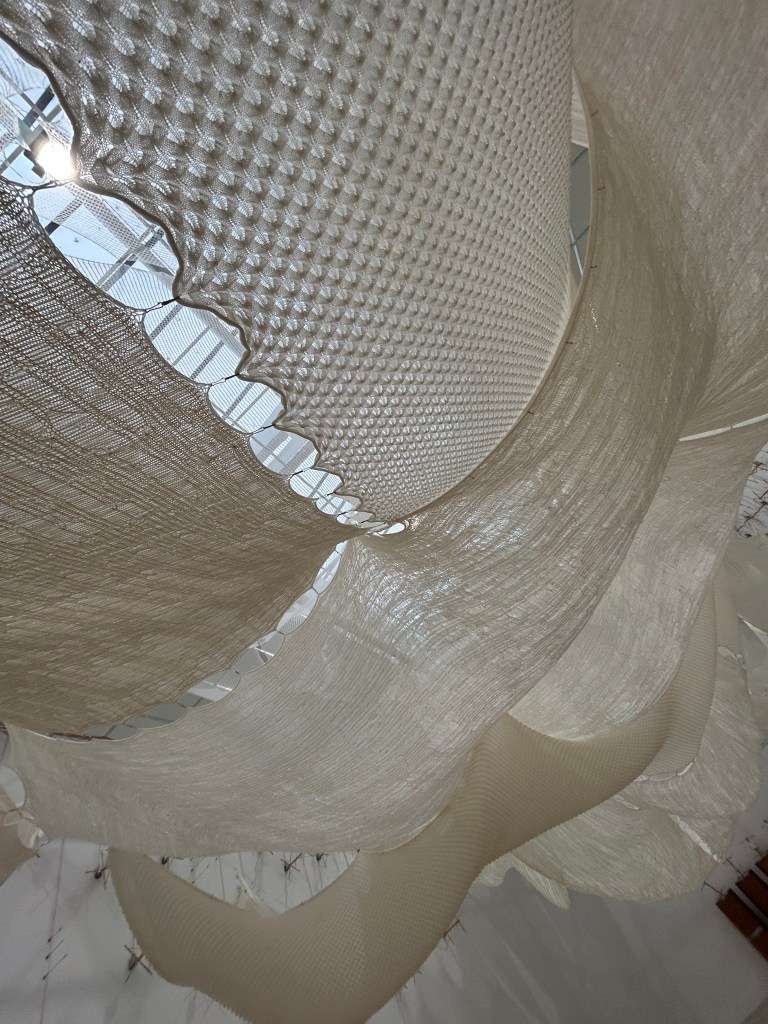
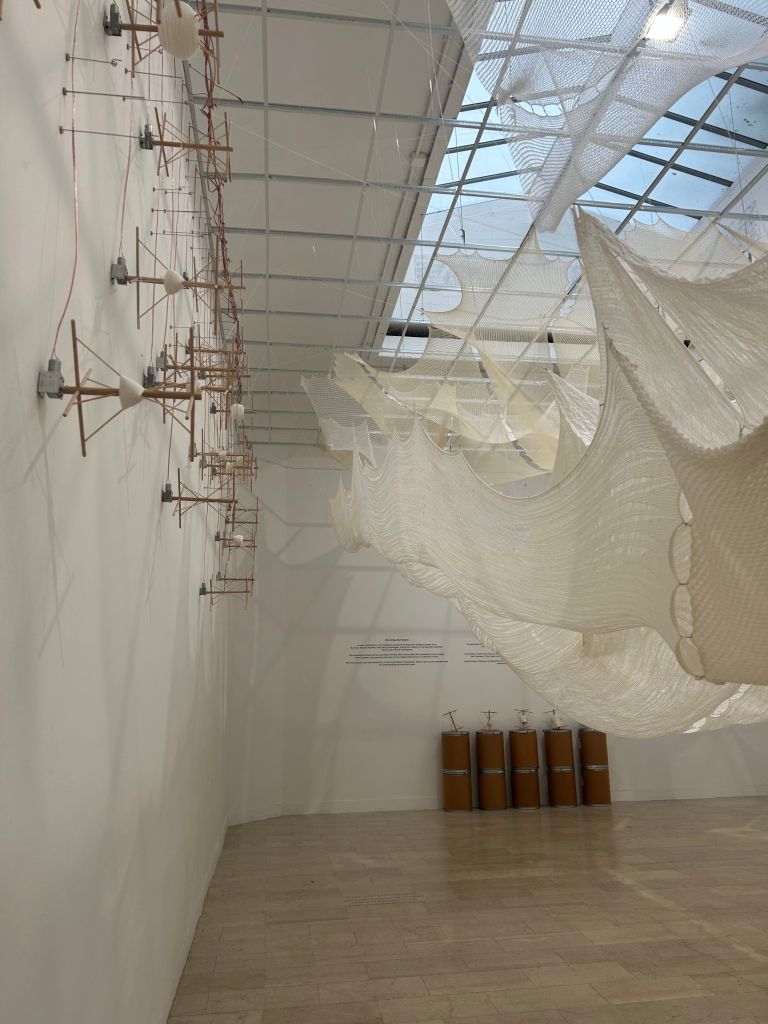
In Venice’s Biennale, the Serbia Pavilion lies with a finished masterpiece–a woven structure hanging from the ceiling. The piece appropriately named Unravelling is composed of several lengths of woven fabrics that are attached to small motors which, over time, will slowly pull the threads until they fully unravel. The central skylight illuminates the white woven cloth, and the various patterns are made obvious. The blank white walls say nothing except to outline the lifespan of this artwork: 6 months. Afterwards, the woven structure will return to its original state of 125 balls of wool.
Traditionally, art was defined as something sculpted out of marble and clay, or something that could be hung on a wall; something that was obvious, that made conventional sense. As we have observed a shift from the Renaissance to the Postmodern period, we start to see that the boundaries for the traditional are broken. It can be seen in the Biennale that art is not only “traditional” art, but architecture and objects that make an impact or statement about our postmodern reality. In the Serbia pavilion, there is no art in a frame or marble sculpture or stained glass, just a wool structure and motors. The inspiration for the rejection of these principles was the shift to technology such as artificial intelligence, which used in the creation of the Serbia pavilion’s exhibit.
The traditional Serbian weaving techniques are a way of connecting old traditions, intricate art, and Serbian heritage, to the newer, minimalistic, chaotic postmodern present. The neutral, earthy colors used in the exhibit are a stark contrast to other pavilions like Japan, that felt constricted and invaded your personal space with loud colors and over stimulating visuals. The soft, open visuals presented in this pavilion invite the audience to make the architecture their own.
Unraveling the Messages
Why Wool?
The fluidity of the medium selected for this exhibit (wool), is representative of the flexibility and creativity characteristic of postmodern thinking. It is subject to change, like how our world’s values and structures are constantly in motion. It shows us that the world we live in is not “fixed” and sturdy, but rather always in motion and not always in a progressive way. The woven structure was made to represent the, “circularity of form and materiality”, the idea of temporality, and to encourage seeking new perspectives for understanding and imagining architectural spaces (Serbia Pavilion).
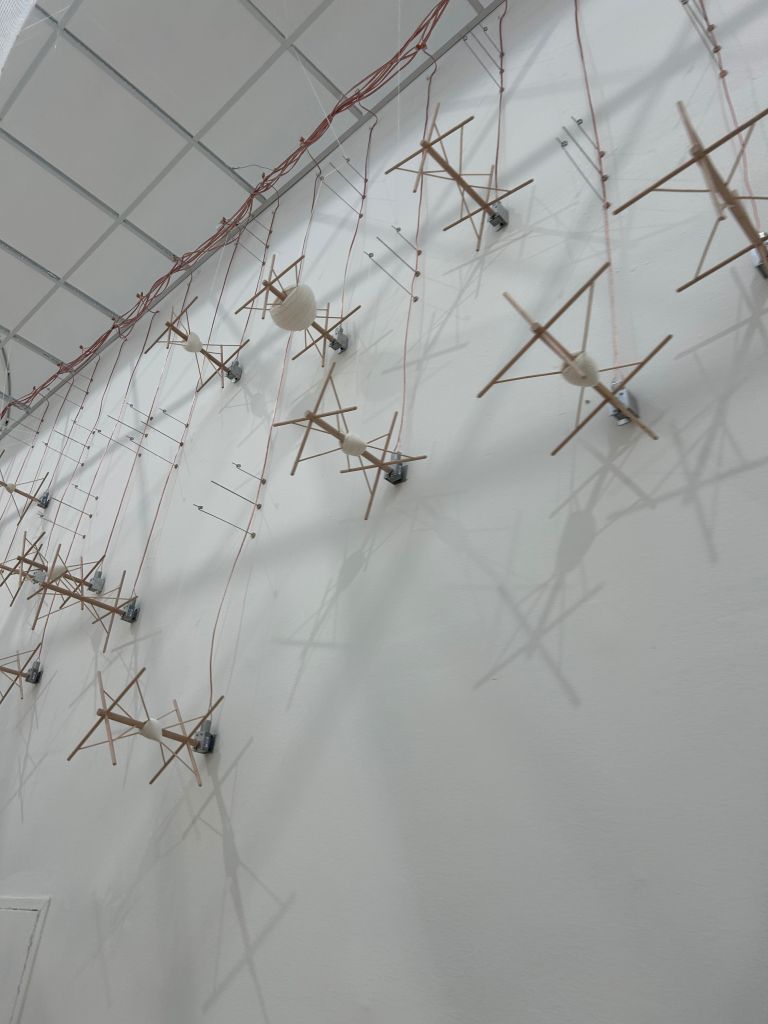
The artwork itself is deeply rooted in traditional knitting practices, therefore emphasizing a shared collective memory which combines tradition with newer elements like artificial intelligence through the use of mechanized motors. It adds that our identities, our pasts, cultures, etc. are intertwined; we all affect each other. Much like how if a thread comes undone, parts of the structure will fall apart, in reality our actions have consequences felt by others. It is a reminder that we are all connected.
Furthermore, since the beginning of time, our world has been evolving according to societal progression, and so the design in the Serbia pavilion is a reflection of that. The fact it was made to be unraveled and destroyed can be interpreted as a statement on the current condition of our world, socially, politically, and ecologically.
Social, Politics, Conflict, Ecological, & Time
Socially, this piece speaks a lot about the temporality of life. One of my favorite sayings, “this too shall pass“, exemplifies this artwork because in November, it too will be gone, and all that will remain is the memory and message felt by all who have visited it. Nothing is ever permanent, so we must learn all we can from it, to become better and evolve.
Despite the fact this piece doesn’t blatantly discuss politics, it invites the reflection and personal interpretation of it. The act of unraveling the wool is a commentary in itself about how select things seem whole, but at a closer glance it is fragile and lacks stability. This touches on institutional distrust, problematic governments, the breaking of connections between nations, resurgence of violent conflicts like war, etc. This exhibit has become a subtle interpretation of uncertainty in our postmodern times.
Additionally, Unravelling embodies messages concerning the ecological state of the world. The use of wool is a sharp contrast to the dominating use of synthetic, artificially created materials seen everywhere. This choice brings the focus back to the natural world and brings us to a simpler, less technological time. The art also brings the idea about the nature is cyclical, not linear, through the ability to unravel and re-knit the wool. Unravelling resists the ideas of growth and progress because it emphasizes renewal and repairing the materials already present.
In The Content of the Form, Hayden White writes, “They refused to tell a story about the past, or rather, they did not tell a story with well-marked beginning, middle, and end phrases; they did not impose upon the processes that interested them the form that we normally associate with storytelling” (2). Though White is discussing historical narratives, his point resonates deeply with the Serbian Biennale exhibit. Like the historians he describes, Unravelling resists a linear structure. Instead of presenting a clear arc or resolution, the artwork unspools slowly and subtly, using open-ended, non-traditional methods to convey its message.
By physically and conceptually undoing itself, the installation challenges assumptions about time, truth, and progress. It suggests that reality is far more complex than simplified linear narratives allow. Our past is not something left behind, but something continually present and influential. The future is not fixed but “re-weavable,” much like the threads of the exhibit; what appears to be an end, can be a new beginning.
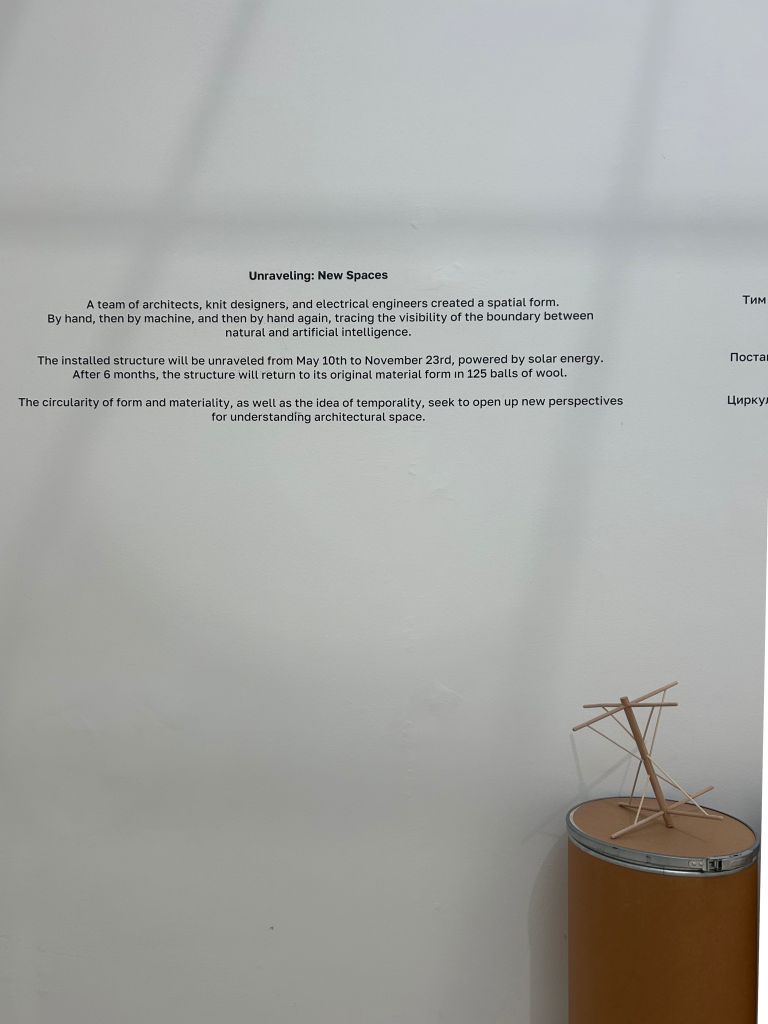
Unravelling also explicitly disrupts the conventional idea of progress as forward motion. It begins with the most “complete” version of the artwork and gradually returns to its raw materials, reversing the expected trajectory. In doing so, it critiques the dominant narrative of constant advancement and invites viewers to reflect on time and change as cyclical, renewable, and nonlinear.
Lessons to Learn
Serbia’s artwork urges us to rethink how we are living our lives within our current time. Unravelling pushes us to rethink what art is and how live in time and our utilization of our resources. It comments on the fragile state of our current reality and how we are all connected. It reminds us that the end is not final, but rather the beginning of something new; that tradition isn’t something to limit us, but rather a stepping stool and a fountain of cultural knowledge.
Thomas Kuhn writes in The Structure of Scientific Revolutions, “Rather what seems to have been involved was the exploration by genius of perceptual possibilities made available by a medieval paradigm shift” (119), suggesting that breakthroughs are not created in isolation, but stem from broader cultural shifts that affect how we perceive the world. The Serbia Pavilion’s Unravelling embodies this idea; it rejects traditional, fixed forms of art and rather embraces impermanence, decay, and cyclical renewal. These themes are only made meaningful within a postmodern paradigm that values process over permanence. Like the paradigm shifts Kuhn describes, the installation invites viewers to see change itself not as loss, but as a creative and necessary act, turning unraveling into a form of revelation.
 Bianca's thoughts