
Love is As Hard As a Rock
What is love? It is a simple question with a very complex answer. Some say love is when your mom makes you breakfast, or others explain it as the phrase, “To be loved, is to be known”. Love is the very thing that people have fought wars over; it sparked revolutions, and driven humanity crazy since the dawn of time.
While walking through Venice on a lovely, sunny day, it began to rain suddenly. Quickly, I ducked into an ivy-lined wooden underpass to seek shelter from the wet rain. As I walked further into the dark underpass, I noticed a small stone sticking out from under the roof. It was barely noticeable from a distance, but as I neared the end of the tunnel, the outline of an object that resembled a heart became increasingly clear.
I reached up to feel the cool stone under my fingertips, its rough surface worn down by visitors over the years. The wishes and prayers of many dreamers had erased its color; what was once red now resembles a burnt sienna. I felt the heart in my hands, closed my eyes, and became a participant in the ritual like others before me: believing that touching the stone will bring good luck in love.
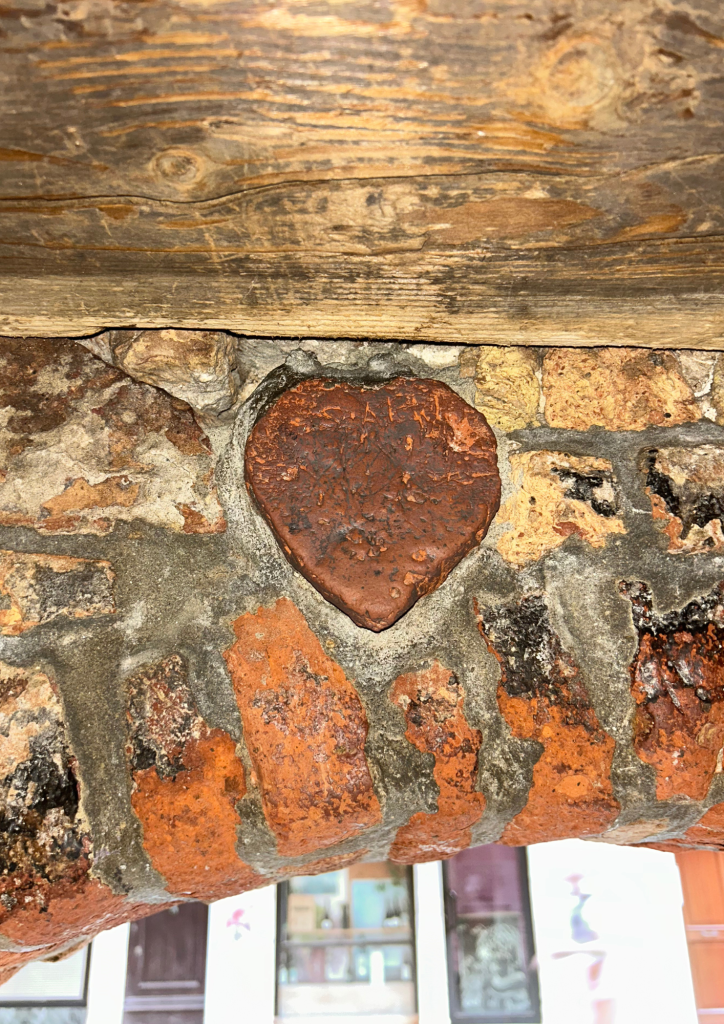
Beneath the quiet Venetian underpass “Sotoportego dei Preti”, between bricks lies a tiny red stone heart. It is the kind of object one could walk past dozens of times without noticing. But once seen and felt, it stays with you. The heart is not polished or grand, it is rough, almost hidden by its surroundings. But maybe that’s why it’s beautiful: it doesn’t seek attention. There is no indication of its existence; it awaits to be discovered, much like love itself.
I chose this heart as my “something beautiful” for this assignment because it is beautiful how millions share a common desire, to find love. Not just any kind of love, but kind, lasting love. The heart under the bridge may just be a rock to some, but to others like me, it represents the hope of something great. The heart under the bridge is hard to find, similar to genuine love and affection.
When the rain cleared, I wanted to take a piece of it with me as I was leaving. I took a picture of the heart almost immediately, and in doing so the emotional weight and impact were lost. De Botton’s On Possessing Beauty states that, “..there was only one way to possess beauty properly, and that was by understanding it, by making oneself conscious of the factors (psychological and visual) responsible for it” (216). This reflection, stemming from Ruskin’s theories, reminds us that beauty isn’t something we can capture and keep, it must be understood; its history and emotional impact are internalized, not just documented.
For example, I saw the heart and took a picture. However, I later realized that the picture has none of what made the heart so special to me. I was moved by it, but I hadn’t understood it. It was only after reflecting on its story, symbolism, and meaning that I began to “possess” its beauty. The photo became less important, and the connection I now have with the stone heart became primary.
De Botton also included in On Possessing Beauty that, “Technology may make it easier to reach beauty, but it does not simplify the process or appreciating it” (219). While he is referring to Ruskin’s connection of traveling fast and far to the inability to appropriately derive pleasure from the details of an object, I feel this still applies to the stone heart because, again, taking a picture of the stone heart reduces the impact it has on the viewer. Part of how people appreciate it is by touching and seeking it out in person, which is elaborate.
This process begins with actually reaching the object so, it involves booking plane tickets, maybe a vaporetto, packing your bags, and financial investments. Then you have to weave through the streets of Venice to reach said object, and that involves researching its location. Furthermore, you have to learn its history to fully understand its context. So, the pilgrimage made to find the heart and be present with it help in possessing its beauty because it allows people to understand and fully absorb it. By performing the act of physically seeking it out, we experience the weight of it because we have invested ourselves in it. This “internal pursuit” of an object we desire to find makes us more likely to take a closer look and slow down to appreciate the details, instead of consuming it in passing.
The stone heart isn’t beautiful simply because it looks a certain way, its beauty lies in what it means. This is present in the story it carries, in the hands that shaped it, and in the reverence people show it. By photographing it without fully grasping the context, I reduced it to surface-level appreciation. As de Botton (through Ruskin) argues, to “possess” beauty truly is to engage with its context. In this way, the act of learning the legend behind the heart (understanding why it matters, and feeling its presence in the place where it lives) is the true act of possession. The photograph is only a keepsake, the understanding is what remains.
For this exercise, our professor challenged us to draw our “beautiful object”, and so my attempt to draw the heart is pictured on the right. I tried drawing it from memory because I thought it would help me understand the rock better. I feel that drawing things we find beauty in from memory allows us to treasure them more due to the fact we have to think about the small details to accurately portray them, and so it forces us to take a closer look.
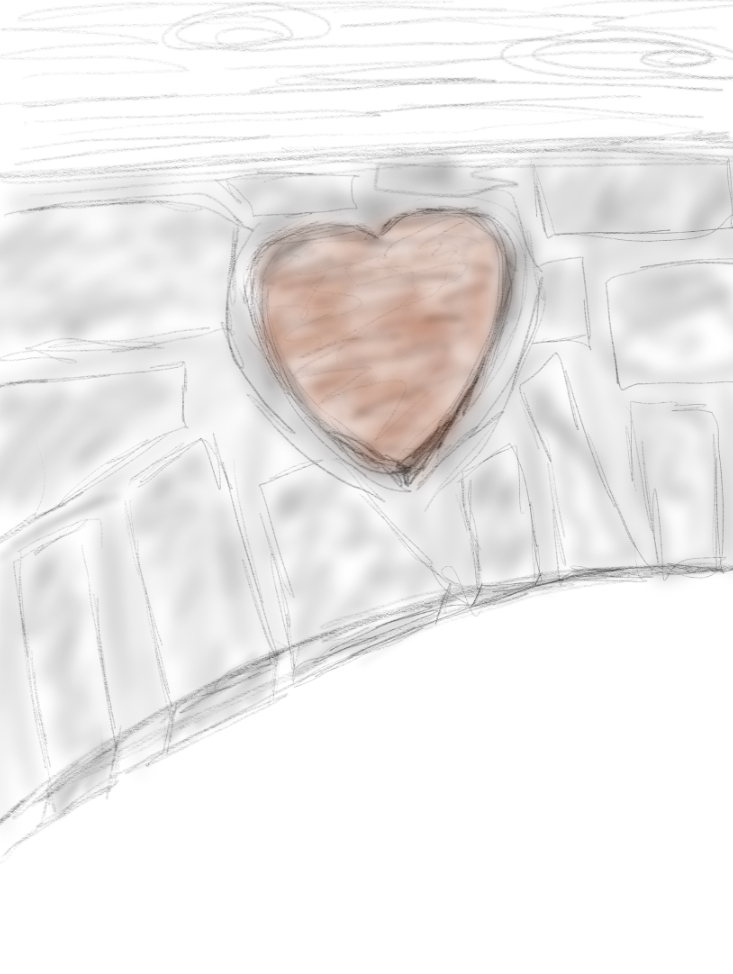
When I first looked at the stone heart, I just got a general idea of what it was: a stone heart on a brick wall. But after drawing it, I noticed the weathered stone, the cracking pavement around it, the orange bricks holding it in place, and the rotting wood in the roof; I finally registered and felt the weight of its presence. The thought of it being there for so long that the area around it was starting to be damaged made it more impactful because I could finally see the impact it had on millions of others.
In reflection, this exercise has helped me reflect on our postmodern approach to daily life by encouraging me to find the beauty in ordinary things. We often treat beauty as something to be collected rather than cherished; we frequently take pictures and then move on, but seldom do we ever go back to those pictures or stay to dwell in the moment. In our postmodern lives, we don’t make time to notice the beauty in the mundane or the extraordinary in the ordinary. The stone heart has taught me that to fully possess something, we have to be present and let ourselves dwell under the weight of it all.
 Bianca's thoughts